
In short
The direct answer
Three numbers dominate linen quotations and each answers a different question. Yarn count describes how fine the thread is; thread count describes how many threads occupy an inch of woven fabric; GSM describes how much the fabric weighs per square meter. Sheets are usually judged on yarn and thread count, towels almost entirely on GSM and loop construction. Knowing which number is load-bearing for which product is what stops a buyer paying for a specification that does not affect the outcome.
Key takeaways
What a buyer should retain
- Yarn count, thread count and GSM describe different properties and cannot replace one another.
- Thread count should be read with warp/filling count, yarn construction, weave and finishing.
- GSM is mass per unit area, not an automatic measure of absorbency, softness or service life.
- A test value applies to the identified specimen and method, not automatically to every future batch.
Decision framework
Questions this guide helps the buying team resolve
Yarn count (Ne): higher means finer
Cotton yarn count in the English system is inverse — 40s yarn is finer than 20s. Finer yarn produces a smoother, lighter, more supple fabric; coarser yarn produces a heavier, more rugged one. A 40s combed cotton sheet and a 20s carded cotton sheet can share a thread count and be entirely different products in the hand and in the wash.
Combed versus carded is a yarn-quality decision
Combing removes short fibers before spinning, producing stronger, smoother, less linting yarn. It costs more per kilogram and shows up as lower pilling and better appearance retention over hundreds of washes. On a long-life hotel program this is frequently better value than an increase in thread count.
Thread count: useful to about 300, then unreliable
Thread count is warp plus weft threads per square inch. Genuine gains flatten around 250–300 for standard cotton weaves; beyond that, headline figures are often produced by counting each ply of a multi-ply yarn separately, so a "600 thread count" may be a 300-count fabric of two-ply yarn. Ask whether the count is single-pick or ply-counted, and ask for the yarn count alongside it.
Weave: percale versus sateen
Percale is a one-over-one plain weave: matte, crisp, breathable, and it tends to look better after institutional laundering. Sateen uses a four-over-one float: smoother and with more sheen, at the cost of somewhat lower abrasion resistance on the exposed floats. Neither is superior in general; they suit different properties and different wash processes.
GSM: the number that governs towels
Grams per square meter is the practical measure of towel substance. Roughly, 400–500 GSM is light and fast-drying, 500–600 GSM is standard hotel weight, 600–700 GSM reads as luxurious, and above 700 GSM the towel becomes slow to dry and expensive to launder. Higher is not automatically better — it is a trade between perceived quality and laundry cost.
None of these numbers substitutes for a sample
Composition, yarn, weave, finishing and the property's wash chemistry interact in ways no single figure captures. For any new construction, the approved physical sample is the specification, and the numbers are how it is described and reproduced.
What each textile number actually measures
| Measure | What it describes | Relevant reference | Buyer use |
|---|---|---|---|
| Yarn count (Ne) | Yarn fineness in the English cotton-count system | State count and ply in the specification | Compare yarn construction before comparing fabric feel |
| End and pick count | Warp and filling yarns per unit distance | ASTM D3775-17(2023) | Check the count method and both fabric directions |
| GSM | Fabric mass per square meter | ASTM D3776/D3776M-20(2025) | Compare weight only with size, yarn and construction held constant |
| Filling weight | Mass of fill inside an insert | Order-specific measurement | Keep separate from shell-fabric GSM |
Evidence: S1 · ASTM International · S2 · ASTM International · B3 · BOREDON
BOREDON weaving base: published equipment and reference output
| Process | Equipment | Reference output |
|---|---|---|
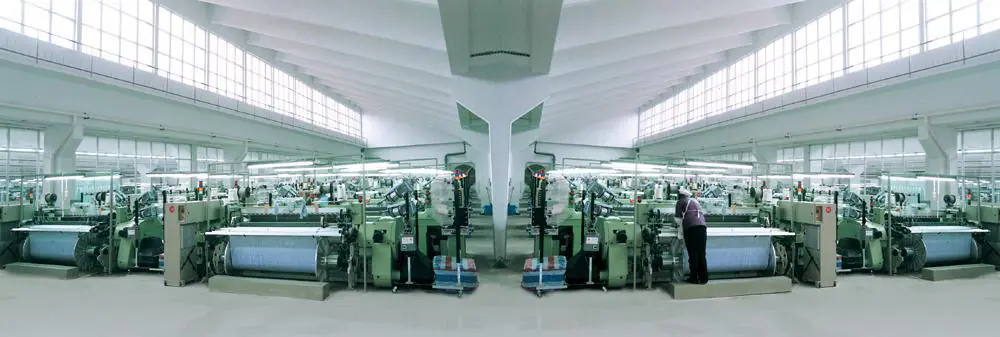
| Air-jet weaving | 50 RFJA20 looms | Approx. 8,000 meters/day |
| Rapier weaving | 200 QFJ788 looms | Approx. 6,000 meters/day |
| Combined weaving base | 250 looms | Approx. 14,000 meters/day under reference conditions |
Actual output varies by fabric width, weave, specification, order mix, shifts and current production schedule.
Evidence: B2 · BOREDON
01
Use the number that describes the product you are buying
Yarn count describes yarn fineness, thread count describes the number of warp and weft threads in a stated fabric area, and GSM describes mass per square meter. None is a complete quality grade. Bed sheets require yarn, weave, density, finishing and finished dimensions to be read together. Towels require GSM to be read with yarn, loop construction, dimensions, border and drying conditions.
For filled products, shell GSM or thread count does not replace filling material, filling weight and construction. For apparel, GSM may matter more than thread count. Start with the product’s operating function, then select the measurements that control that function.
Supporting evidence: S1 · ASTM D3775-17(2023): End and Pick Count of Woven Fabrics · B3 · Published Product Specifications
02
Read thread count together with yarn count, ply and weave
A thread-count number can be increased by counting plied yarn components differently, so ask whether the figure represents actual warp and weft threads and whether the yarn is single or multi-ply. Also request the yarn count and weave. Percale and sateen using the same nominal thread count can feel, drape and launder differently because their interlacing structures are different.
A high number is not automatically the best commercial choice. Finer yarn and denser construction can create a smoother product, but they may also affect price, drying behavior and tolerance of aggressive laundry conditions. Approve the stated construction or physical fabric rather than purchasing a number in isolation.
Supporting evidence: S1 · ASTM D3775-17(2023): End and Pick Count of Woven Fabrics
03
Use GSM as a weight input, not a softness claim
GSM allows buyers to compare fabric weight on the same area basis. It is essential for towels, bath mats, robes, workwear and some protectors, but equal GSM does not guarantee equal absorbency, softness, lint behavior or durability. Yarn quality, loop height, twist, pile density, finishing and border construction all contribute to the result.
Heavier textiles also increase wash load, drying time, storage volume and freight weight. The right GSM balances guest or user experience with the laundry’s actual equipment and energy constraints. Request a sample and, where necessary, define the relevant test method rather than treating heavier as universally better.
Supporting evidence: S2 · ASTM D3776/D3776M-20(2025): Mass Per Unit Area of Fabric · B3 · Published Product Specifications
04
Translate the specification into inspection points
A quotation should preserve the agreed composition, yarn or GSM reference, weave or construction, finished dimensions and tolerance. The approved sample records appearance and hand feel. Incoming material and production checks then compare the relevant construction, while finished inspection confirms dimensions, workmanship, identification and packing.
If laboratory verification is required, identify the sample, standard, test item, sampling method and acceptance criterion. A historic report for another fabric can support supplier review but should not be used as a batch guarantee for a different construction. BOREDON’s testing-report center presents each published report at its actual sample scope.
Supporting evidence: B3 · Published Product Specifications
05
Ask these questions when two fabric quotations look identical
Confirm fiber composition, yarn-count system, single or multi-ply yarn, warp and weft construction, weave, finished width, finishing process, dimensional-change requirement and color or whiteness reference. Then check whether both quotations use the same finished product dimensions, quantity, packing and commercial term.
If one supplier cannot explain how the stated fabric connects to an approved sample and finished-product specification, the comparison is incomplete. A technically clearer quotation is easier to inspect, easier to reorder and less likely to create a price increase later through omitted construction or finishing requirements.
Supporting evidence: B4 · Complete Testing Reports
Evidence and sources
References used in this guide
BOREDON figures are linked to the corresponding factory, product or testing page. External standards link to the issuing organization. Order-specific performance remains subject to the released specification, approved sample and applicable test method.
- B2Equipment & Reference CapacityBOREDON
Published equipment counts and reference output, subject to specification and scheduling.
- B3Published Product SpecificationsBOREDON
Confirmed sizes, materials, MOQ and lead-time ranges from the C1 product database.
- B4Complete Testing ReportsBOREDON
Public report sets with report number, sample scope, test basis and result.
- S1ASTM D3775-17(2023): End and Pick Count of Woven FabricsASTM International
Official scope for measuring warp and filling count in woven fabrics.
- S2ASTM D3776/D3776M-20(2025): Mass Per Unit Area of FabricASTM International
Official scope for measuring fabric mass per unit area.
Buyer FAQ
Questions buyers ask about this topic
What thread count sheets do hotels use?
Hotels do not use one universal thread count. A useful specification also states yarn count, weave, construction, finish and laundering needs. Compare an approved sample rather than treating the largest thread-count number as a quality guarantee.
Is 1000 thread count better than 300?
Usually not, and often it is not a true 1000. Genuine improvement flattens around 250–300 for standard cotton weaves, and very high figures typically come from counting plies. A 300-count combed cotton percale generally outperforms a nominal 1000-count fabric of weaker yarn in institutional use.
What GSM should hotel bath towels be?
500–600 GSM covers most hotel programs. Below 450 the towel reads as thin; above 700 drying time and laundry cost rise noticeably. The correct figure depends on your positioning and your drying capacity.
Does GSM apply to sheets?
It can be quoted, and it is a useful cross-check on substance, but sheets are conventionally specified by yarn count, thread count and weave. GSM is the primary measure for terry and for table linen.
When was this guide last reviewed?
Reviewed 4 August 2026. GSM and thread-count bands are practical industry references, not standards, and should be confirmed against an approved sample.