
In short
The direct answer
Towels are the textile guests handle most and the one that costs the most to launder. The purchase decision therefore has two halves: how the towel feels in the bathroom, and what it costs to wash and dry for the next three years. GSM answers neither on its own — a heavy towel with poor yarn absorbs badly and dries slowly, which is the worst of both outcomes.
Key takeaways
What a buyer should retain
- Compare finished size, GSM, yarn, loop construction, border and laundering requirements together.
- Heavier towels require more wash, drying, storage and transport capacity.
- Order quantities should be calculated by room allocation, operating units and par level.
- Approve white shade or custom color, border and branding before bulk production.
Decision framework
Questions this guide helps the buying team resolve
Set GSM from positioning and drying capacity
400–500 GSM suits budget, gym, pool and high-turnover use where fast drying matters. 500–600 GSM is the standard hotel band. 600–700 GSM reads as luxury. Above 700, drying time and energy cost rise sharply and the towels occupy more linen-room space. Choose the band deliberately against your laundry's actual capacity, not aspirationally.
Ask about yarn before weight
Combed long-staple cotton absorbs faster, lints less and holds its loop through more washes than short-staple carded yarn at the same GSM. Zero-twist and low-twist constructions feel notably softer and more absorbent but are less abrasion-resistant, which suits a resort spa better than a 300-room city hotel.
Specify the size, not just the type
"Bath towel" spans roughly 68 × 137 cm to 76 × 152 cm, and bath sheets run larger again. Size drives both cost and laundry weight more than most buyers expect, and a towel quoted at an attractive GSM in a smaller size is not the bargain it appears. Always compare GSM and dimensions together.
Budget for lint and first-wash behavior
All new cotton terry lints. Combed yarn and proper finishing reduce it; a few industrial washes clear most of it. Plan for the towels to be laundered before first guest use, and treat a supplier who claims zero lint from new as unreliable rather than impressive.
Choose the border and branding for the laundry
A woven dobby border is more durable than a printed one and is where a jacquard property name normally sits. Embroidery is available and adds a point that can catch in industrial handling — position it deliberately. Confirm artwork, placement, dimensions and thread colors on the approved sample.
Set par levels from occupancy, not room count
A towel set per occupied room per day, times pars, plus pool and spa demand, plus a loss allowance — pool towels in particular disappear at rates that surprise first-time buyers. Three to four pars is a common working range for hotel bath linen.
Confirmed hospitality towel specification ranges
| Product | Published size | Published weight | Reference MOQ / lead time |
|---|---|---|---|
| Washcloth | 30 × 30 to 35 × 35 cm | 400–550 GSM | Min. 100 pcs / 20–35 days |
| Hand towel | 40 × 75 cm confirmed example | Confirm with quotation | Min. 100 pcs / 20–35 days |
| Bath towel | 80 × 150 cm confirmed example | Confirm with quotation | Min. 100 pcs / 20–35 days |
| Bath mat | 45 × 75 to 50 × 80 cm | 650–1,000 GSM | Min. 100 pcs / 20–35 days |
| Hospitality spa towel | 35 × 75 or 40 × 80 cm | 350–600 GSM | Min. 100 pcs / 20–35 days |
Lead times are reference ranges and depend on specification, customization, quantity and scheduling.
Evidence: B3 · BOREDON
Towel-selection trade-offs
| Decision | If increased | What to verify |
|---|---|---|
| GSM | More mass, storage volume and drying load | Actual finished GSM and tolerance |
| Finished size | More material and laundry load per piece | Post-care dimensions and tolerance |
| Soft-twist construction | Softer initial hand may change abrasion behavior | Approved sample and wash evaluation |
| Custom color | Adds color approval and lot-control requirements | Reference shade, tolerance and wash requirement |
Evidence: B3 · BOREDON · B4 · BOREDON
01
Choose the towel program around guest use and laundry capacity
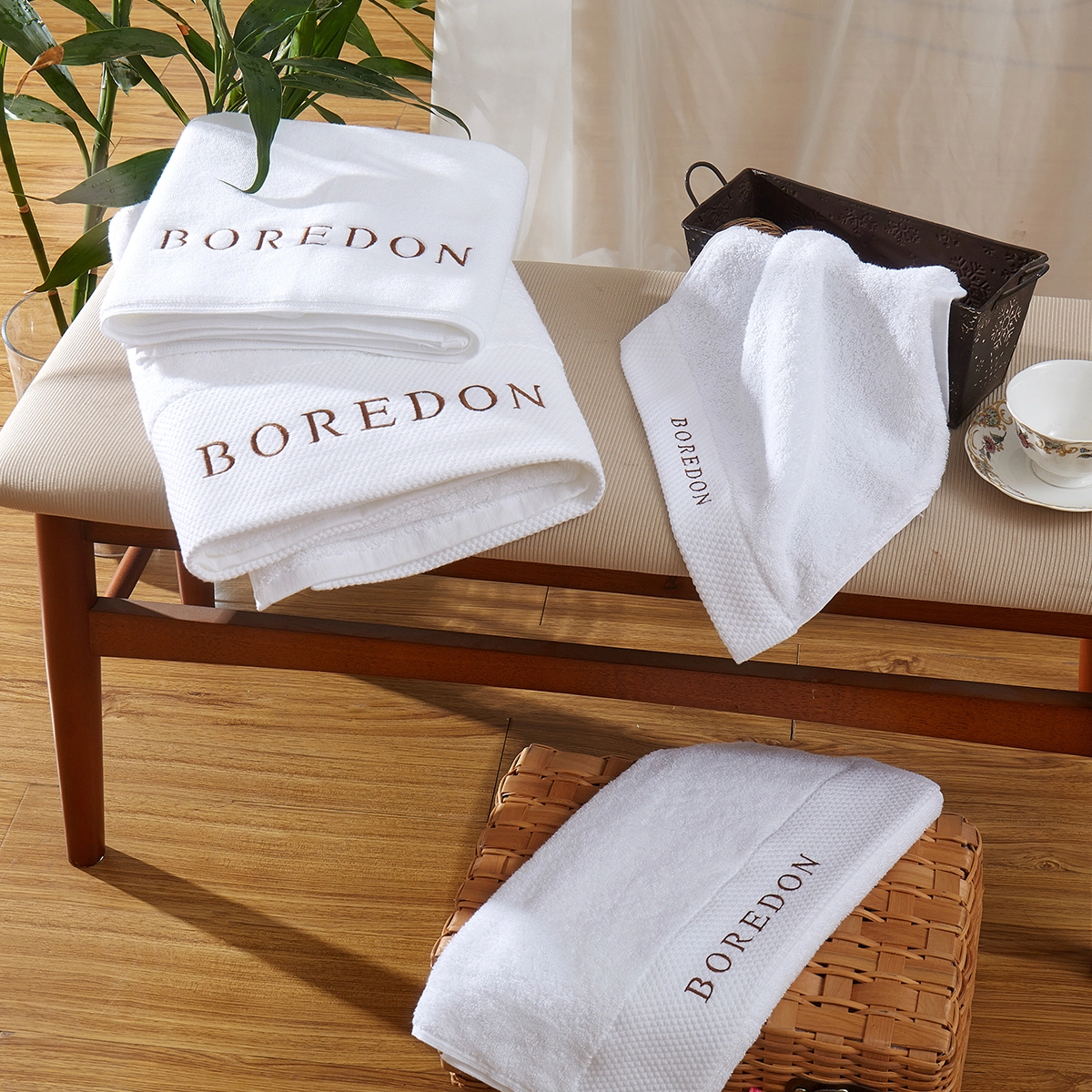
Start by separating washcloths, hand towels, bath towels, bath mats, pool towels and spa towels. Each serves a different function and should have its own finished dimensions, GSM, yarn or loop construction, border, color and quantity. Then match the program to the laundry’s washer capacity, extraction, dryer capacity and required room-turnaround time.
A heavier towel can feel substantial but occupies more machine volume, retains more water and normally requires more drying energy. A lighter towel can improve throughput but must still meet the desired absorbency, coverage and guest presentation. The best specification is the one the property can wash, dry and replace consistently.
Supporting evidence: B3 · Published Product Specifications · S2 · ASTM D3776/D3776M-20(2025): Mass Per Unit Area of Fabric
02
Evaluate absorbency, lint and edge construction with GSM
GSM states weight, not performance. Ask how the yarn, loop pile, twist and finishing support absorbency, and inspect the sample after the agreed initial wash because finishing residues can affect first-use behavior. Check lint under the laundry process the property actually uses rather than relying on a generic claim.
Borders and hems deserve equal attention. A decorative border that draws differently from the terry body can distort after repeated laundering, while weak edge construction often fails before the pile is worn out. Record border dimensions, hem construction and appearance requirements on the approved sample.
Supporting evidence: B3 · Published Product Specifications
03
Calculate quantity from allocation, par and replacement
For each room type, record the number of each towel placed in the room. Multiply by the number of operating rooms and the selected par level, then add opening or replacement stock according to occupancy, laundry turnaround and loss experience. Pool and spa products should be calculated from treatment or guest throughput rather than guestroom count.
Keep quantities separated by size, color, border and logo because minimum order quantity applies to the individual production variation. A mixed order may be large in total but still contain several small lines. Consolidating unnecessary variations can improve purchasing efficiency without changing the guest experience.
Supporting evidence: B3 · Published Product Specifications
04
Approve white shade, custom color and branding before production
White is not one universal color. If towels must match existing stock, provide a physical reference and state how shade will be approved. For custom colors, use an agreed physical standard or recognized color reference and understand that dye-lot minimums and tolerances apply. Evaluate the color after the intended wash process where shade retention matters.
For embroidery, provide authorized vector artwork, finished dimensions, placement and thread colors. Confirm whether the logo affects the usable surface or creates a stiff area. Woven labels, size identification and carton marks should be approved with the same discipline as the towel itself.
Supporting evidence: B3 · Published Product Specifications · B5 · Quality Control Process
05
Compare total operating cost, not only purchase price
A towel’s commercial cost includes purchase, freight, wash chemistry, water, drying energy, labor, storage, replacement and guest-service consequences. Compare candidate samples using the property’s wash and dry process, record dry weight and cycle behavior, and observe absorbency, lint, dimensional change, edge condition and appearance over a defined trial.
BOREDON can quote from a line-by-line specification and review sample development with the manufacturing group. The final decision should combine the measurable construction, approved sample, laundry trial where appropriate, landed cost and the records retained for repeat orders.
Evidence and sources
References used in this guide
BOREDON figures are linked to the corresponding factory, product or testing page. External standards link to the issuing organization. Order-specific performance remains subject to the released specification, approved sample and applicable test method.
- B3Published Product SpecificationsBOREDON
Confirmed sizes, materials, MOQ and lead-time ranges from the C1 product database.
- B4Complete Testing ReportsBOREDON
Public report sets with report number, sample scope, test basis and result.
- B5Quality Control ProcessBOREDON
Specification release, in-process inspection, final inspection and packing controls.
- S2ASTM D3776/D3776M-20(2025): Mass Per Unit Area of FabricASTM International
Official scope for measuring fabric mass per unit area.
Buyer FAQ
Questions buyers ask about this topic
What GSM is best for hotel towels?
500–600 GSM suits most hotel guestrooms. Go lighter for pool, gym and high-turnover use; go heavier only if your laundry can dry them economically and you have the storage.
Are heavier towels more absorbent?
Not necessarily. Absorbency comes from fiber quality, loop structure and twist. A well-constructed 550 GSM combed cotton towel frequently outperforms a poorly made 700 GSM one, while drying considerably faster.
How many towels per room should we buy?
Multiply the towel set per occupied room by your par level — commonly three to four — then add pool, spa and gym demand and a loss allowance. Provide your occupancy and laundry cycle and the quantities can be calculated with you.
What are the reference MOQs for towels?
Confirmed towel references generally show a regular MOQ of 300 pieces and a minimum of 100 pieces per item and size.
When was this guide last reviewed?
Reviewed 4 August 2026. GSM bands are practical references rather than standards and should be confirmed against an approved sample.