
HOTEL PRE-OPENING PROCUREMENT
Hotel Pre-Opening Linen Package: Sizing, Par Levels and Phased Delivery
A reliable pre-opening linen package starts with a room-by-room matrix, finished dimensions, opening allocation and laundry turnaround—not a generic quantity per key. Freeze the approved sample before bulk production, phase delivery by operational priority, and retain specification and packing records for replenishment.
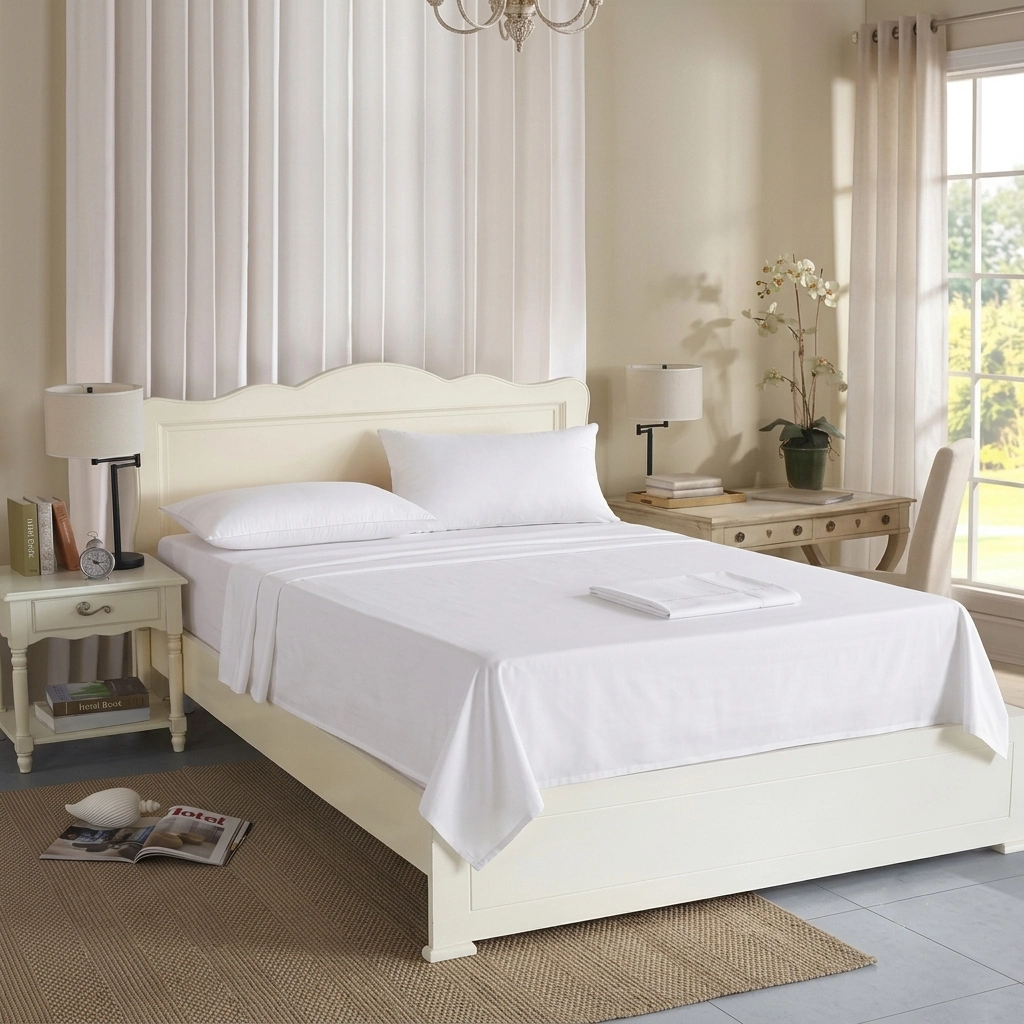
What belongs in a hotel pre-opening linen scope?
A pre-opening linen package is an operating system expressed as products. It normally covers guestroom bed linen, bath linen, bedding inserts, protectors, housekeeping stock, spa or pool linen where applicable, restaurant and banquet linen, staff-use items and a controlled replenishment reserve. The procurement task is not simply to buy “three sets per room.” It is to connect every item to a room type, installed dimension, use point, laundry route and opening milestone.
Start with the property schedule. List sellable rooms, mock-up rooms, accessible rooms, connecting configurations, suites, rollaway requirements and any owner-use or staff accommodation separately. Then record the actual mattress, topper, duvet insert and pillow dimensions. Market labels such as king, queen or twin are useful for conversation but are not manufacturing dimensions. A quotation line needs finished width and length, construction, material, color, quantity and packing.
The same discipline applies outside guestrooms. A restaurant table-linen count depends on table combinations, service periods, change practice and outsourced or on-site laundering. Spa towels depend on treatment throughput and turnaround. Pool towels depend on issue and return control. These demand drivers should not be forced into the guestroom formula.
Use the hotel linen buying guide to structure the requirement, the hotel linen size guide to verify dimensions and the online product catalogue to identify the relevant product families.
How do room matrices become purchase quantities?
The basic formula is:
Opening quantity = operating units × allocation per unit × selected par + non-room stock + approved contingency.
“Operating units” may be rooms, beds, tables, treatment rooms or daily users. “Allocation” is the number physically placed at one time. “Par” is the number of complete operating cycles held by the property. It should reflect the time from removal to return, not a benchmark copied from another hotel.
| Calculation input | What it proves | What the buyer receives |
|---|---|---|
| Room and bed matrix | The exact population of each installed size | A quantity schedule separated by room type and finished dimension |
| Allocation per room | The pieces simultaneously in use | A defensible baseline before par and reserve are added |
| Laundry turnaround | Time between collection and clean return | A par decision connected to actual operations |
| Occupancy and opening phase | How quickly stock enters circulation | A phased release plan rather than one undifferentiated delivery |
| Replacement and loss policy | How replenishment will be governed | A reserve quantity and repeat-order trigger |
Consider a 120-room property with 100 standard rooms and 20 suites. If standard rooms use one king set and suites use one king plus one sofa-bed set, those are already two specification lines before par is considered. Pillowcase quantities often have a different multiplier from sheets because a bed may carry four pillows. Bath towels, hand towels, washcloths and bath mats each require their own allocation. Combining them into “one bathroom set” hides the figures needed for production, packing and replacement.
Directional benchmarks can help a buyer test whether a result looks plausible, but they are not a specification. A 3-par assumption may work where laundry returns within the operating day and deliveries are dependable. Longer turnaround, high occupancy, seasonal isolation or off-site processing may justify more. Conversely, opening every reserve carton on day one destroys the distinction between operating stock and contingency.
Which specifications must be frozen before bulk production?
The purchase order should identify every variation that changes material, machine setting, sewing or packing. For woven sheets and duvet covers, record composition, yarn construction, weave, end and pick count, finished size, opening or closure, hem, color reference and labeling. ASTM D3775-17(2023) describes methods for end and pick count; it does not turn a marketing thread-count number into a complete quality statement.
For towels, state finished size, mass per unit area, yarn or loop construction, border, color and logo. ASTM D3776/D3776M-20(2025) covers mass per unit area. GSM remains a weight measure, not a guarantee of absorbency, softness or service life. For pillows and duvets, separate shell construction from fill type and fill weight. For protectors, specify the required construction without assuming unverified waterproof, anti-slip or medical performance.
Care requirements belong in the same document. ISO 3758:2023 provides a care-labelling code using symbols, while ISO 6330 describes domestic washing and drying procedures used for testing. Neither standard supplies a universal shrinkage limit. The buyer and supplier must agree the test procedure, conditioning, number of cycles and acceptance criterion.
A useful release package contains:
- a signed or otherwise approved physical sample;
- a revision-controlled product specification;
- artwork and placement for authorized branding;
- a color reference where shade matching matters;
- label and carton-mark layouts;
- unit, inner and master-packing quantities;
- an inspection basis and any agreed test references;
- the final destination and required delivery sequence.
BOREDON’s quality-control process explains how released specifications, in-process checks, final inspection and packing records connect. Public testing reports show report numbers and sample scope; a result applies to the identified specimen and method, not automatically to every future batch.
When should the mock-up room and laundry trial occur?
Approve appearance and fit in the installed environment before the full room count is released. A mock-up room exposes problems that spreadsheets do not: insufficient sheet tuck, a fitted-sheet pocket that ignores the topper, a duvet cover that is too tight for the insert, pillowcases with inadequate overlap, or towels whose border and color conflict with the bathroom scheme.
Where the property’s laundry process is known, a controlled wash trial can be more useful than an isolated showroom impression. Record the wash program, chemistry, temperature, drying method and cycle count. Inspect finished dimensions, seam condition, shade, lint, handle and pressing behavior against the agreed acceptance basis. Do not describe one trial as a lifetime guarantee; it is evidence for a defined sample under a defined process.
The mock-up decision should create documents, not informal messages. Photograph the approved installation, identify the sample, record the revision and make every later change traceable. If a designer changes the color or the operator changes the bed build-up, recheck the affected lines before production.
How should production and delivery be phased?
A sensible opening program separates decisions that need early certainty from stock that can arrive later. The exact schedule depends on specification, customization, quantity and current production scheduling, but the logic is stable.
- Technical definition: finalize room matrix, measurements, product construction and destination requirements.
- Sample development: approve fabric, workmanship, dimensions, branding and packing.
- Mock-up and training stock: provide controlled quantities for installation checks, photography, housekeeping training or laundry trials.
- Bulk release: lock revisions and issue the production schedule by product family.
- Inspection and packing: identify cartons by property, area, room type, item, size and quantity.
- Delivery sequence: release opening-critical stock before secondary or replenishment stock where the logistics plan permits.
- Handover: transfer the final specification index, packing list, inspection status and repeat-order reference.
Weaving, quilting, filling, sewing, inspection and packing are connected within the Wangda Textile manufacturing system in Xi’an. The published base comprises approximately 20,359 m² of self-owned industrial land, approximately 7,000 m² of self-built workshops and 250 looms. Reference output varies with construction, order mix, shifts and current scheduling; it must not be converted into an unconditional lead-time promise. See the manufacturing base and equipment and capacity page for the confirmed figures and capacity boundary.
What should carton marks and handover records contain?
The first delivery is also the data foundation for every replenishment order. Carton marks should be readable by the receiving team and connect to the purchase order. Useful fields include property, department, product, finished size, color, quantity, carton number, gross and net weight where required, and an approved item reference. If several opening phases share a shipment, the packing list should preserve the phase or destination zone.
Retain the approved sample, specification revision, order line, test or inspection references, artwork and packing record. A future buyer should be able to request “the approved king duvet cover, revision B” rather than reconstructing it from a photograph. Repeat orders still require review because yarn, dye lot, component availability and schedules can change, but written references materially reduce ambiguity.
For multi-property groups, use a controlled core specification with clearly identified local variations. This supports consolidated production without pretending that every property uses the same bed size, laundry process or label language. The repeat-order consistency guide provides a practical document chain.
Which cost numbers should decision-makers compare?
A comparable quotation holds the specification and commercial basis constant. The unit price alone cannot reveal whether one offer omits a closure, uses a different weight, changes packing or assumes a different quantity per size. Compare material and construction, sample and testing requirements, branding, packing, quantity by variation, delivery basis and destination together.
For operations, calculate cost per occupied room or per use with a stated denominator. Include purchase, freight, washing, drying, handling, loss, damage and replacement. If the denominator excludes complimentary rooms, staff use, spa stock or banquet events, state that. CPOR can guide an operating decision only when the calculation boundary is visible.
Self-owned land and self-built workshops can reduce exposure to factory rent, lease expiry and relocation, but they do not guarantee the lowest price or perfect quality. Quality remains controlled by the approved specification, sample, production checks and order records. Actual prices and lead times depend on the released requirement.
What information produces a useful pre-opening RFQ?
Send one spreadsheet or schedule with a line for each measurable variation. Include property type, room count by configuration, installed dimensions, product category, finished size, material or performance target, color, quantity, logo or private-label need, packing, target delivery sequence and destination. Add the laundry arrangement, expected opening date and the decisions still awaiting operator or designer approval.
If a healthcare or care-facility area forms part of a mixed development, list those ordinary textile requirements separately. BOREDON does not imply sterile, antimicrobial, protective, treatment or medical-device performance. Any requested barrier or regulated performance must identify its own standard, class, test method and expected evidence as a separate RFQ line.
Evidence and working references
- ASTM D3775-17(2023), End and Pick Count of Woven FabricsASTM International
- ASTM D3776/D3776M-20(2025), Mass Per Unit Area of FabricASTM International
- ISO 3758:2023, Care labelling code using symbolsInternational Organization for Standardization
- BOREDON manufacturing baseBOREDON
- BOREDON equipment and reference capacityBOREDON
Hotel pre-opening linen FAQ
How many sets of bed linen does a new hotel need?
Calculate each item separately: operating rooms × pieces placed per room × selected par level, then add opening contingency and non-room stock. The correct par depends on occupancy, laundry turnaround, collection timing, storage and replacement policy; it is not one universal number.
Should every item use the same par level?
No. Sheets and pillowcases may follow one laundry cycle, while duvets, protectors, bathrobes, pool towels and banquet linen follow different soil, drying and replacement patterns. Assign par by item family and operating workflow.
When should a hotel approve linen samples?
Approve the measurable sample before bulk release: finished size, composition, weave or construction, color reference, sewing, closures, labels and packing. If laundering changes acceptance dimensions or appearance, approve the agreed washed condition as well.
Can a factory split the opening order into phases?
Yes, subject to technical review and production scheduling. A useful sequence is mock-up and training stock, first-room release, operational back-of-house stock and replenishment reserve. Each phase should keep the same approved specification reference.
Does BOREDON publish a fixed hotel-opening lead time?
No. Lead time depends on product construction, size and color variations, branding, quantity, test or sample requirements, packing, production mix and destination. The final schedule is confirmed only after technical review.